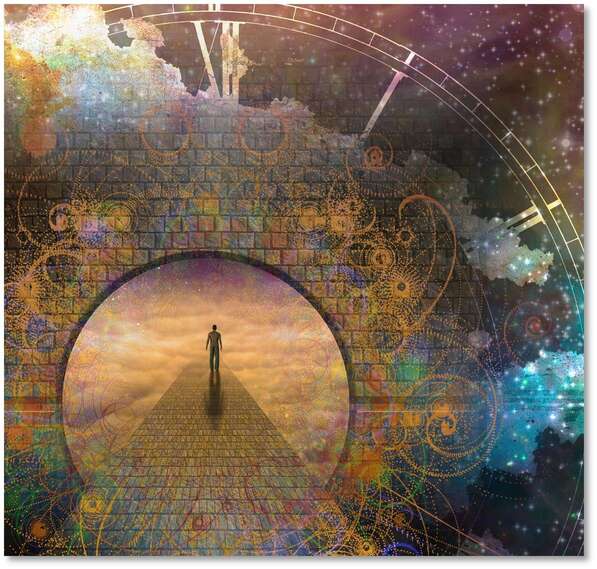
Reality by Consensus
Perception and indoctrination define our reality. Both conspire to ensure you overlook that there is more to our existence than meets the eye
boy on a bike, Robin Williams joked in one of his stand‑up sets. “He could do all sorts of tricks with that bike that I thought were impossible, until the day he learned about gravity.” It’s a funny moment, but it also points to something people rarely stop to think about. With that offhand comment, Williams touched on a deeper truth about life. The world is full of mystery and wonder, yet our sense of what’s possible is often limited by what society tells us is acceptable.
Consensus forms when certain ideas get repeated over and over until they start to feel like the only reasonable way to see things. Your understanding of the world is shaped by the beliefs of your family, friends, peers, and other influential people around you. Sometimes their ideas come from insecurity or fear. They may worry that if someone sees the world differently, it will expose their own worldview as flawed. And because we’re social creatures, we naturally want approval. We want to be liked, to fit in, to feel like we belong. When we don’t go along with the beliefs we’ve been taught, there’s a real fear of being pushed out or rejected by the group.
Many belief systems are just a common language for people seeking meaning in life.
Many belief systems work like a shared language for people who are trying to make sense of life. From the moment you’re born, other people’s ideas about what life means start shaping the way you’re expected to see the world. You’re told what’s right, what’s wrong, and how you’re supposed to think. When you question any of it, you might hear things like “You’re wrong” or “You shouldn’t think that way.” If your perspective doesn’t match the people around you, you can be pressured to fall in line. And when your worldview differs too much, you might even be labeled as radical, unstable, or in need of help. In some cases, people face social consequences like being pushed out of groups, dismissed as irrational, or treated as if something is wrong with them.
Because humans are social by nature, we’re wired to protect our connections. That instinct can make it hard to think differently from the group, since standing out can feel like risking rejection. To stay accepted, people often give up parts of themselves to fit in. But that acceptance comes with a cost: losing pieces of their individuality. Fear and insecurity can cloud our perception too, keeping us from noticing that there’s more to our existence than what we immediately see.
It’s still an open question whether the reality we experience exists on its own or whether it’s shaped by the act of observing it. Do we build reality through our language and perceptions, giving form to what we encounter? Or is reality something fixed, something our thoughts and observations have to adjust to?
This tension between what exists and how we perceive it sits at the center of how we understand consciousness, knowledge, and truth. Are we simply watching a world that’s already there, or are we helping to shape it? Perhaps reality itself is a fluid innerplay, where perception and external conditions co-create the experiences we call real.
Our understanding of reality is shaped by our five senses, which are imperfect, and by the information we receive from others. Because of that, we may never have a complete picture of what’s true. There are real limits to what we can know. Gregory Bateson, the English anthropologist and social scientist, suggested that to truly understand a system, you have to look at it from the outside, from a kind of “meta” level where the patterns and relationships become visible. Since we’re living inside the system we’re trying to understand, we rely on perception to make sense of our world.
The human mind and eye have an incredible ability to interpret what’s around us. We don’t just see what’s in front of us. We fill in gaps, connect fragments, and create a smooth story out of incomplete information. In a way, we’re always crafting an illusion, which shows just how powerful our imagination and perception really are.
Perception is the process that helps us make sense of the stimuli we encounter. It’s based on how we interpret sensations, but our senses aren’t always reliable. When light enters the eye, for example, the image that lands on the retina is upside down. The brain flips it and fills in missing details so we can see something coherent. It also blends in other signals, including emotional cues from the body, to form our interpretation of the moment. That interpretation is shaped by our senses, our memories, our conditioning, and whatever we’re feeling at the time. To keep things stable, the brain tends to create a picture of reality that lags slightly behind the present, rather than processing everything instantly. The result is often ambiguous and open to personal interpretation.
What we perceive is only a small slice of the vast reality around us. It’s interesting to imagine what might happen if we allowed ourselves to consider that there could be more to existence than what our senses can detect. What if there are aspects of reality that anyone could explore, if they were open to the possibility?
Some people believe that the brain has mechanisms that limit or filter out unusual or intuitive experiences, almost like a built‑in inhibitor. In this view, people may have untapped capacities for deeper insight or heightened awareness, even if they don’t recognize them. Exploring these ideas doesn’t require taking them as literal fact. It can simply be a way of expanding how we think about the mind and our place in the universe.
Opening ourselves to possibilities like this can shift how we see reality and lead to new insights about who we are. It invites us to explore the parts of ourselves that often stay dormant.
If we never question our assumptions or try to understand what shapes our perception, we risk being swept along by life without any real sense of direction, like a leaf carried by a river. Many people fall into this pattern. They stop questioning the beliefs they were raised with and accept whatever they’re told about the world. They become another “brick in the wall,” a familiar copy of the people around them. Some try to stand out by adding a bit of sparkle, but underneath it all, their worldview remains almost identical to everyone else’s.
Lazy by Design
Facts stand. Faith endures. But belief is the one realm we are free to reshape, and in that reshaping, the Spiritual Warrior discovers the path forward.
Why are people so open to indoctrination? Part of it comes down to how we’re built. Humans like to conserve energy, and real critical thinking takes effort. It’s tiring to question everything you see and hear, so most of us don’t do it unless we have to. Fear plays a role too. We want to belong. Challenging the beliefs of our family or friends can feel risky because it might lead to rejection or ridicule, and that’s something most people instinctively avoid.
Psychologists often describe the mind as having two modes. System 1 is quick, emotional, and automatic. System 2 is slower, more analytical, and much more demanding. Since System 2 burns more energy, the body naturally prefers to lean on System 1. That’s one reason people fall into “reality by consensus.” It’s simply easier to accept what others say than to dig deeper and think for yourself. This same tendency helps explain why memes spread so easily. They’re simple, catchy ideas that require almost no effort to absorb, and people pass them along without stopping to question them.
If you want to drift through life like a leaf on a river, it might feel easier. You’ll blend in, and you may even have more social harmony. But if you want to rise above ignorance and pursue something closer to wisdom, you have to take a different path. That means becoming a kind of inner warrior, someone willing to pause, reflect, and make intentional choices. It means questioning your own assumptions and not accepting beliefs just because they were handed to you.
We all seek happiness, and for a spiritual warrior, happiness is achieved by adhering to a consistent set of basic beliefs in life.
We all want to be happy, and for someone who sees themselves as a spiritual warrior, that happiness comes from living by a steady set of core beliefs. A good place to start is by choosing a few basic axioms you trust even if you can’t prove them. Once you have those, you can build a small set of tenets, the beliefs you’ve examined and decided truly matter to you. For example, you might choose to live by the idea that in any situation you should give more than you take. Each tenet should stand on its own and not overlap or contradict the others. When your tenets are consistent and you stay committed to them, you’re likely to feel less stress, enjoy better health, and experience more happiness. But don’t stop at happiness. Aim for a sense of exuberance. If your beliefs clash with each other or you don’t follow them, you’ll eventually feel inner conflict, stress, and unhappiness.
A clear set of beliefs also makes decision-making easier. Every choice you make can be measured against your tenets. This helps you become more self-reliant and gives you a stronger sense of control over your life. Instead of drifting without direction, you begin living with intention. That shift alone can reduce fear and conflict. The real goal is to loosen your grip on old defenses and familiar assumptions so you can see the world in a new way, shaped by the tenets you’ve chosen for yourself.
When you change your worldview, you open the door to parts of reality you may have overlooked. These less ordinary aspects of experience are available to anyone who’s willing to explore them. To reach them, you have to connect with the deeper, energetic part of yourself that most people barely notice.
The Philosophy of Self
People often think of their “self” as something tied closely to the physical body. It includes our identity, our senses, our emotions, and the way we take in the world around us. The physical sense of “I” forms in a part of the brain called the anterior precuneus. This region works with other areas of the brain to combine information about where we are, how we move, and what we feel in our bodies. Together, they shape our awareness of being a person in a particular place and moment. This first‑person point of view is unique to each of us, but it can also be narrow. It naturally centers the world around our own experience, which can limit how we see things.
When we connect with our spiritual self, we can move beyond that tight focus on our physical identity. Spiritual awareness opens the door to deeper connections with other people and with the world as a whole. Empathy is a key part of this shift. It helps us understand what others feel and gives us a more balanced view of both our environment and ourselves. When we try to see life through someone else’s eyes, our understanding widens and our perspective becomes richer.
Alongside the physical and spiritual aspects of who we are, there is also an energetic self that many people overlook. This is a subtle but powerful field of energy that flows from within us and surrounds us. It interacts with everything in our environment, living or not, and links us to the larger fabric of existence.
Everything in the universe has its own natural vibration, from the ground beneath us to a chair in the room, to plants, animals, and people. This vibration is often described as a resonant frequency. When our own energy aligns with these frequencies, we enter a state of coherence. In this state, our energy becomes more stable and expansive, and we may feel more alive, more aware, and more connected to the world around us.
Each person has a distinct energy signature that sets them apart from others.
Each person carries a unique energy signature, a vibrational imprint as individual as a fingerprint. This signature shapes the way we interact with others, how we respond to different environments, and how we experience life as a whole.
Think about those moments when you instantly connect with someone you’ve just met, or when you feel an unexpected sense of calm while sitting on a rock in nature. Experiences like these may come from energetic synchrony, the moment when your energy signature aligns with that of another person or object. It’s why we sometimes “click” with certain people or feel naturally drawn to particular places.
On the other hand, feeling uneasy in a new space or around someone unfamiliar can come from a mismatch in energetic frequencies. Harmony tends to create connection and clarity, while dissonance can lead to tension or a sense of being out of place.
When we learn to tune in to our energetic selves and the frequencies around us, we open ourselves to a more intuitive, vibrant, and connected way of living.

Your body gives off subtle fragments of energy that move and ripple, much like the energy that radiates from the sun. This energy usually gathers into an aura that surrounds you, reaching about an inch beyond your skin. For some people, the aura stretches several inches or even several feet. There are also individuals who release sudden bursts of energy that resemble a solar flare. These kinds of events show up in what many describe as non‑ordinary reality, which will be explored in the next section.
The energetic side of who you are is real, yet it often goes unnoticed or dismissed. This energy acts as a bridge to a part of reality we tend to overlook, and it offers a way to move beyond the limits of ordinary perception. At first, this expanded view of the world can feel surprising or even overwhelming. With time, though, the initial mix of awe and uncertainty fades, and this new perspective becomes something you can weave naturally into your everyday life. When you learn to sense the energy that flows from people and objects, you gain access to a kind of direct knowing that doesn’t rely on the usual intuitive or analytical processes.
Quantum Consciousness
Consciousness is essentially your sense of being alive and aware; of noticing yourself, your thoughts, your feelings, and the world unfolding around you. Scientists have spent decades trying to understand where these inner experiences, often called qualia, actually come from. Some describe consciousness as a steady stream of thoughts and perceptions, while others believe it arises from intricate brain activity that we’re only beginning to grasp.
Throughout a single day, we slip in and out of different states of consciousness: fully awake and focused, drifting through daydreams, or sinking into sleep. These states can also shift in more intentional ways, whether through meditation, hypnosis, or certain substances. Each altered state gives us a slightly different perspective on just how fluid and adaptable our inner experience can be.
A unified theory of consciousness and the energetic nature of being draws from quantum mechanics, neuroscience, and philosophy, pushing back against traditional ideas about how consciousness forms and functions. This kind of interdisciplinary thinking suggests that consciousness might not be just the end result of neural wiring and chemical reactions. Instead, it may be tied to deeper quantum processes unfolding within the brain.
One of the most compelling ideas in this area is the Orchestrated Objective Reduction (Orch‑OR) theory, developed by physicist Roger Penrose and anesthesiologist Stuart Hameroff. According to this view, consciousness doesn’t arise solely from communication between neurons. Rather, it emerges from quantum activity inside microtubules, the tiny cylindrical structures that help maintain a neuron’s shape and stability. Orch‑OR proposes that these microtubules carry out quantum computations, giving rise to conscious experience through mechanisms that go beyond what classical neuroscience can explain. This challenges the long‑held belief that consciousness is nothing more than a byproduct of complex neural interactions and instead highlights the possibility that quantum features like entanglement and coherence may be central to understanding what consciousness really is.
Although the theory was met with skepticism at first, new research has begun to examine whether quantum effects can occur in living systems. Some studies suggest that quantum mechanics may play a role in processes such as photosynthesis and even our sense of smell. These findings hint that quantum behavior may not be limited to the subatomic world. If such effects can exist within biological systems, then the idea that they might contribute to consciousness becomes more plausible, encouraging scientists and philosophers alike to revisit long‑standing assumptions about the nature of the mind.
A key idea in quantum mechanics that supports this view is superposition, a phenomenon at the heart of quantum computing. In a classical computer, a bit can only be a 0 or a 1. In a quantum computer, a qubit can be both 0 and 1 at the same time because of superposition. This gives quantum computers an enormous advantage, since they can process huge amounts of information in parallel instead of step by step.
A simple way to picture superposition is to think of a coin flip. While the coin is spinning in the air, it isn’t strictly heads or tails. It’s in a kind of in‑between state that can be thought of as both. Only when it lands and we look at it do we find out which side it shows. Quantum systems behave in a similar way, remaining in multiple states at once until they are observed or measured.
If we apply this idea to the brain, it opens the door to the possibility that quantum processes inside neurons could allow the brain to handle information far more efficiently than traditional models suggest. For example, a system with just 53 quantum bits, or qubits, can represent more than a quadrillion (10^15) bits of information in a billionth of a second. If something comparable were happening inside neurons, it might help explain the remarkable speed, intuition, creativity, and sudden insights that often accompany conscious thought.
Quantum mechanics does more than explain computation and particle behavior. It is closely connected to energy and the ways energy changes form. One of the most significant ideas in quantum theory is the principle of energy conservation, which tells us that energy cannot be created or destroyed but only transformed. If consciousness has an energetic aspect, this raises the possibility that it might continue beyond physical life by shifting into another form rather than disappearing.
This idea resonates with many spiritual traditions that suggest consciousness extends beyond the physical world. If energy is eternal, then the core of who we are, whether described as consciousness, soul, or an energetic presence, may persist after death. This way of thinking brings together scientific understanding and deeper metaphysical questions, opening new paths for exploring how quantum physics, consciousness, and spirituality might intersect.
By connecting insights from neuroscience, quantum mechanics, and philosophical views on the energetic nature of being, this approach encourages us to reconsider what consciousness is, how we relate to the universe, and how quantum principles might influence our understanding of reality in ways science is only beginning to uncover.
Non-Ordinary Reality
It is so much simpler to bury reality than it is to dispose of dreams.Don DeLillo
“Non‑ordinary reality” describes experiences that might seem strange or unusual to someone who sees the world in a very limited way. This could include moments like predicting something before it happens or watching a person seem to vanish right in front of you. People often brush these things off as coincidences, imagination, or a delusion, but if you’re open to the idea that reality can be bigger and more flexible than it appears, and you’re willing to move past fear, experiences like these can start to feel surprisingly normal.
Arthur C. Clarke, the well‑known science fiction writer, once pointed out that any advanced technology can look like magic to someone who doesn’t understand it. As people learn more and become familiar with new technologies, what once seemed mysterious starts to feel ordinary. The same idea can be applied to non‑ordinary reality. As your understanding grows, what once felt impossible may begin to feel like a natural part of how the world works.
By discarding the limitations of social conditioning and embracing inquisitiveness and openness, we can unearth the boundless marvels of the universe that extend beyond our everyday perceptions.
As Hamlet says in Shakespeare’s play, “There are more things in heaven and earth than are dreamt of in your philosophy.” I’ve had moments in my own life that seem to reach beyond what we usually think of as possible. These kinds of experiences aren’t reserved for a select few. Anyone can tap into a wider sense of reality if they’re willing to stay open and let go of old fears and assumptions. When we loosen the grip of social conditioning and approach the world with curiosity and openness, we start to uncover the countless wonders that exist just beyond the edges of our everyday awareness.
“Spidey Sense”
Sometimes I get this strong intuition about things that haven’t happened yet, almost like a gut feeling. It reminds me of the “spidey sense” from Spider‑Man, that subtle alert that something important is happening. When it kicks in, I feel unusually aware of potential danger or key details, and it often feels surprisingly accurate.
The distinction between past, present, and future is only a stubbornly persistent illusion.Albert Einstein
This feels different from regular intuition, which is more like a vague sense about a situation. My spidey sense has never been wrong. Friends sometimes ask me to use it to guide them, but it doesn’t work on command. These flashes of knowing just show up on their own, without any warning. Some scientists even suggest that time might not be linear, which makes me wonder if these moments are actually memories of events that haven’t unfolded yet from our point of view.
One of the clearest examples happened while I was watching the State of the Union with a friend. Out of nowhere, I had this sudden thought that someone in the audience would stand up and shout from the balcony during the President’s speech. A little later, that exact thing happened when the father of a high school student killed in a shooting was escorted out after shouting from the balcony. People might chalk it up to coincidence, but my flashes tend to be precise in a way that’s hard to ignore.
Another time, as I was leaving my mother’s house after visiting her and my cousin, I turned to say goodbye. I suddenly felt that something wasn’t quite right. I paused before saying, “See you, Mum.”
“What’s up?” she asked.
I told her I had a feeling I would come across a deer near my home and that I needed to be careful not to hit it. My mother already knew about these premonitions because she had seen them happen before. My cousin, on the other hand, was skeptical and didn’t believe in anything like that.
Even with their different reactions, the prediction came true. As I approached my home at the top of a hill, I remembered the deer and slowed down. Sure enough, a six‑point buck appeared by the side of the road just a few feet in front of my car. It looked at me for a moment, then calmly crossed to the other side, completely unharmed.
Was it intuition or some kind of sixth sense that helped me avoid a dangerous situation? Or was the deer somehow communicating with me through energy so we wouldn’t collide? Whatever the explanation, I avoided harm to myself, the animal, and my car. It made me wonder whether the deer would still have been there if I had stopped for snacks or taken a slightly different route. Was the encounter meant to happen, or could a tiny change in my plans have shifted everything?
Another episode happened recently during a hurricane. I was watching from the safety of my porch as 100‑mph winds and heavy rain tore through the area. While looking at the line of trees in my neighbor’s backyard, one tree stood out to me. I felt certain it was going to fall. It stayed upright through the storm, though. A week later, another intense storm rolled in and knocked out the power. I drove to a friend’s house to shower, and as I passed behind my neighbor’s home, I saw the road completely blocked by that same tree I had singled out earlier.
The most profound moment involving my spidey sense happened while my mother was dealing with serious health problems. She had smoked for years and struggled with COPD and emphysema. Even with oxygen treatments, doctors told her she had about a year left. Five years later, I was visiting her and trying to figure out how to help her stay in her apartment instead of moving into a skilled nursing home. I lived too far away to support her directly, but I had a friend nearby who was unemployed. I was considering paying him to help with errands like groceries and banking so she could remain at home longer.
Then I felt something shift. I had a strong, unshakable sense that her health was about to decline and that my friend’s help wouldn’t be needed after all. When I arrived at her home again, the feeling hit me so hard that I told her I believed she would die soon. She didn’t brush it off. Instead, she took it seriously and called her sisters so they could visit one last time and help her prepare. A few weeks later, she passed away. Because of my past premonitions that had come true, she trusted what I told her and used that time to get ready for the end.
Disappear From the Face of the Earth
In the middle of all the daily hustle and bustle, it can feel incredibly refreshing to step away for a moment and disappear into nature. Picture yourself drifting down a river on a warm, sunny day with not a single cloud in the sky. It’s such a simple pleasure, but it has a way of easing the weight of everyday responsibilities.
Lexy, a coworker I had only recently gotten to know, and I decided to spend a slow, easy afternoon floating down the river near our homes. The sun was bright, the sky was clear, and everything felt calm as we drifted along on our inner tubes. After a few hours, we headed toward the riverbank. No one else was around, and the spot we ended up in was surrounded by trees, a stretch of grass, and rows of corn climbing up a hill.
The moment we stepped out of the water, the weather shifted in a way that didn’t feel natural. Dark clouds rushed in and seemed to hang just above us. The sunlight vanished, and it suddenly felt like twilight. The wind picked up so fast that we had to shout just to hear each other. It felt like the air itself was pressing in on me, and there was a strange buzzing in my ear.
Lexy started to panic. She yelled my name and reached out like she couldn’t see or hear me at all, even though I was right beside her. Fear completely took over and she began to cry. The whole thing was unsettling and confusing for both of us.
Then, just as quickly as it had come on, the strange weather disappeared. Everything went back to normal. Lexy looked at me with this shaken expression and asked, “Where did you go? Why did you leave me?” The experience rattled her so much that she still refuses to talk about it.
Ghosts Can Be So Mischievous
I once visited Lexy one evening after she bought an old house. It had all the usual features you’d expect, like hardwood floors, a dishwasher, and two bathrooms, but it also came with something extra: a ghost. According to Lexy, the ghost was an old woman who had probably owned the place long ago.
As we walked through the house, she showed me each room except for one bedroom on the second floor. That room was off limits. She said that was where the ghost supposedly lived. When we made our way back downstairs, we noticed something strange. All the lights that had been on earlier were now off. It felt like the ghost wanted us to know she was there.
Later that night, when I left Lexy’s house, I found that the lights on my motorcycle weren’t working. They’d been fine earlier, and the engine started without any trouble, so I knew the battery wasn’t dead. No matter how many times I flipped the switch, the lights stayed dark. I couldn’t help wondering if the ghost Lexy told me about had something to do with it. Still, I wasn’t about to let a ghost keep me from heading home.
I rode through the city using only the streetlights to see, trying the switch every so often just in case. Several miles later, when I reached the interstate, I started to worry about how dangerous it would be to ride down a pitch‑black highway at night with no lights. And right then, as if on cue, the lights flicked on. After that, I didn’t have a single problem with them.
I Know What You’re Thinking
Sometimes I feel a surge of energy rise up from my gut, almost like it’s reaching outward and looking for someone who’s giving off the same kind of spark. When those two bursts meet, it’s as if I suddenly tap into a direct stream of what the other person is thinking. I’ll say things we’ve never talked about, or bring up details about them that I shouldn’t logically know. The connection can last for hours when someone is open to it, but most people get overwhelmed and pull away after a few minutes.
Non-ordinary reality experiences, such as these instances of mind reading or energy connection, can be unsettling for those who encounter them.
Non‑ordinary experiences like moments of mind reading or energetic connection can be unsettling for the people who stumble into them. I’ve initiated this kind of connection before, and once, someone else initiated it with me and unintentionally tried to pull on my energy. I ended the connection and asked them to leave so I could protect myself. When they later tried to explain what happened to others, they were met with disbelief. Still, having even one person who can acknowledge the experience can bring a sense of grounding and make it feel less strange. These experiences may be unusual, but they aren’t rare, and they can open the door to curiosity and exploration.
The next day, the person who had connected with me wanted to learn more about the energetic self they had accessed. But because they reached it without any preparation and immediately became overindulgent, I felt it was better to step back. They weren’t ready to fully engage with the depth of non‑ordinary reality. It really does help to have some understanding and a sense of readiness before trying to access that kind of energy.
Light up the Room
The energetic self can also show up in a way that makes two or more people “light up a room.” This doesn’t mean their auras literally glow. It’s more that the energy of several individuals blends and expands until it fills the entire space. When you’re with the right person, this can feel incredibly pleasant. The energy around you becomes serene and protective, almost like returning to the safety of the womb. In that state, doubt, insecurity, and worry tend to fall away.
Sophie, a massage therapist, has experienced this “lighting up a room” effect with other therapists. It happens during sessions when both people are relaxed and fully present, allowing the shared energy to grow, spread, and fill the room. You can imagine it as a merging of colors, accompanied by a deep sense of peace.
I don’t fear these unusual moments. To me, they feel as ordinary as getting up in the morning to make breakfast. Still, the scientific part of me can’t help exploring the edges of these experiences. Once, Sophie was sitting in the lotus position with her eyes closed, letting the energy flow. I sat near her and tried to move my hands in front of her body, but something stopped me. It felt like an invisible force that kept my hands from getting within a foot of her. No matter how hard I tried, I couldn’t enter her space. She had no idea I was even there. I was fascinated, but eventually I let it go. After all, this is a non‑ordinary reality, and in that space, anything seems possible. Sometimes the best thing you can do is relax and enjoy it.
You’re Pregnant
My partner stepped off a plane after a two‑week vacation. The moment I saw her, I said, “You’re pregnant.”
It was news to her, but a few days later it was confirmed.
A little while after that, my hairstylist apologized for rescheduling our appointment. I asked, “Did you have a doctor’s appointment about your baby?”
She stared at me, completely bewildered. “How did you know? I haven’t even told my friends yet.”
The body goes through subtle changes at the very start of pregnancy. Maybe I’m just more perceptive than most people, but I’ve always felt that the energetic self within each of us gives off something that certain people can sense and interpret. Pregnancy is especially easy to pick up on in that way. Before any obvious physical changes appear, there’s a quiet shift in a woman’s energy, and some of us can feel it.
Medical Intuition
“Remember how I told you I’ve been getting a pain in my stomach?” Dylan said over the phone. “A couple of days ago I bent over in pain on the elevator and couldn’t get up off the floor. I saw a doctor and he scheduled me for gallbladder surgery next week.”
“Dylan, it’s not your gallbladder. Something’s wrong with your lower spine.”
What did I know? Dylan was a close friend who lived hours away, but he’d seen my spidey sense kick in more than once. I hadn’t seen him in a year, yet I called him out of nowhere with this gut feeling that something was off with his health. He took it seriously and scrambled to get a second opinion about the stomach pain. He managed to book a last‑minute appointment with a doctor who was about to leave for vacation.
After an exam and a scan, the doctor found a tumor wrapped around Dylan’s lower spine. Without surgery within the next month, he said Dylan would likely be paralyzed for life. Thankfully, Dylan had the surgery in time and made a full recovery.
Manifest Destiny
Your energetic nature allows you to connect with both living and nonliving things throughout the universe, because everything carries its own unique form of energy. When we learn how to work with that energy, we can influence our surroundings and shape reality in ways that support what we want. This is the essence of manifestation.
Manifestation isn’t just wishful thinking. It’s the practice of directing your energy toward a specific goal with intention, focus, and belief. Sometimes it’s as simple as holding a clear thought, emotion, or intention long enough for it to create a ripple effect that pulls your desired outcome closer. Some people think of this as aligning with universal forces, while others see it as a way of training the subconscious mind so that your choices and actions naturally lead you toward success.
Even though the idea can sound unconventional, many people say they’ve experienced powerful results through consistent manifestation practices like visualization, affirmations, meditation, or prayer. Across different cultures and belief systems, there’s a long‑standing belief that human consciousness can influence reality. It suggests that our connection to the universe isn’t limited to the physical world but extends into the energetic and even quantum levels of existence.
A person’s intent could act as a catalyst, initiating a chain reaction … and ultimately manifesting desired events.
The idea of an energetic self often overlaps with concepts from quantum mechanics, giving rise to what some call “quantum consciousness.” This perspective suggests that consciousness might be fundamentally linked to quantum processes. If you take this idea further and include quantum entanglement, a person’s intent could act as a spark that sets off a chain reaction through this strange phenomenon, eventually helping to bring certain events into reality.
Quantum entanglement itself is extraordinary. When two or more particles become entangled, they stay connected in such a deep way that whatever happens to one instantly affects the other, no matter how far apart they are. This kind of instant connection goes against our usual understanding of space, distance, and cause and effect.
If you apply this to manifestation, you could imagine that a person’s focused intent might tune their energy to particular quantum states, creating a kind of resonance. By working with their energetic nature, which some see as a blend of consciousness and quantum activity, they might theoretically influence entangled particles. Those particles could then interact with others, setting off a chain of tiny quantum shifts that eventually show up as changes in the physical world.
Many people don’t accept the idea of manifestation, and instead place their trust in the principles of local realism. Local realism, a cornerstone of classical physics, is built on a few basic assumptions. One is locality, the view that an object can only be influenced by events in its immediate surroundings. Something happening in one place cannot instantly affect something far away. Another is realism, the belief that physical properties exist independently of our observation. In this view, objects have definite characteristics such as position, momentum, or spin, whether or not anyone is measuring them.
Quantum mechanics, however, challenges these assumptions through phenomena like entanglement. In an entangled system, measuring one particle appears to instantly influence the state of another, even when they are separated by great distances. This behavior seems to violate the principle of locality and raises deep questions about how the universe actually works.
More evidence against local realism came from the Big Bell Test, a global experiment that used crowdsourcing, networking, and even game-like tools to involve people around the world. By gathering huge amounts of random, human-generated data, the study produced strong empirical results that contradicted local realism. The correlations seen between entangled particles couldn’t be explained by hidden variables, which gave even more support to the predictions of quantum mechanics.
Although quantum mechanics mainly describes the microscopic world, some quantum effects can appear on larger scales under the right conditions. Researchers have even observed entanglement in macroscopic systems, suggesting that quantum behavior might influence broader physical processes.
With this in mind, the idea of manifestation, which suggests that an energetic self can shape events through intention or will, may not be as far-fetched as it once seemed. If consciousness is connected to quantum processes, then the possibility that focused intent could interact with entangled particles to create real-world change becomes an intriguing idea. It opens the door to further exploration where physics, philosophy, and the study of consciousness meet.
In my experience, manifestation comes with a very distinct feeling, almost like a “click,” that tells me the intention I’ve set is already moving into place. It feels like a quiet confirmation that my focus has lined up with the energy around me.
I’ve used this practice to bring about many different outcomes, from the gender of my child to unexpected financial help when I needed it most, and even clear weather on a day when rain was in the forecast. Some people may see manifestation as pseudoscience, but for me it has been a meaningful and powerful way to create positive change. I’ve seen the results often enough that it’s hard to ignore the possibility that consciousness and energy interact in ways we don’t fully understand yet.
Even so, I try to approach manifestation with care. Channeling energy can be draining, and I’m aware that shifting events in my favor might affect someone else in ways I can’t predict. For example, manifesting a new job for myself could mean someone else misses out on an opportunity they really needed. Because of that, I try to be thoughtful and responsible with what I choose to manifest, using it sparingly and with intention. I want to honor my own path while also respecting the journeys of others, keeping in mind how connected everything truly is.